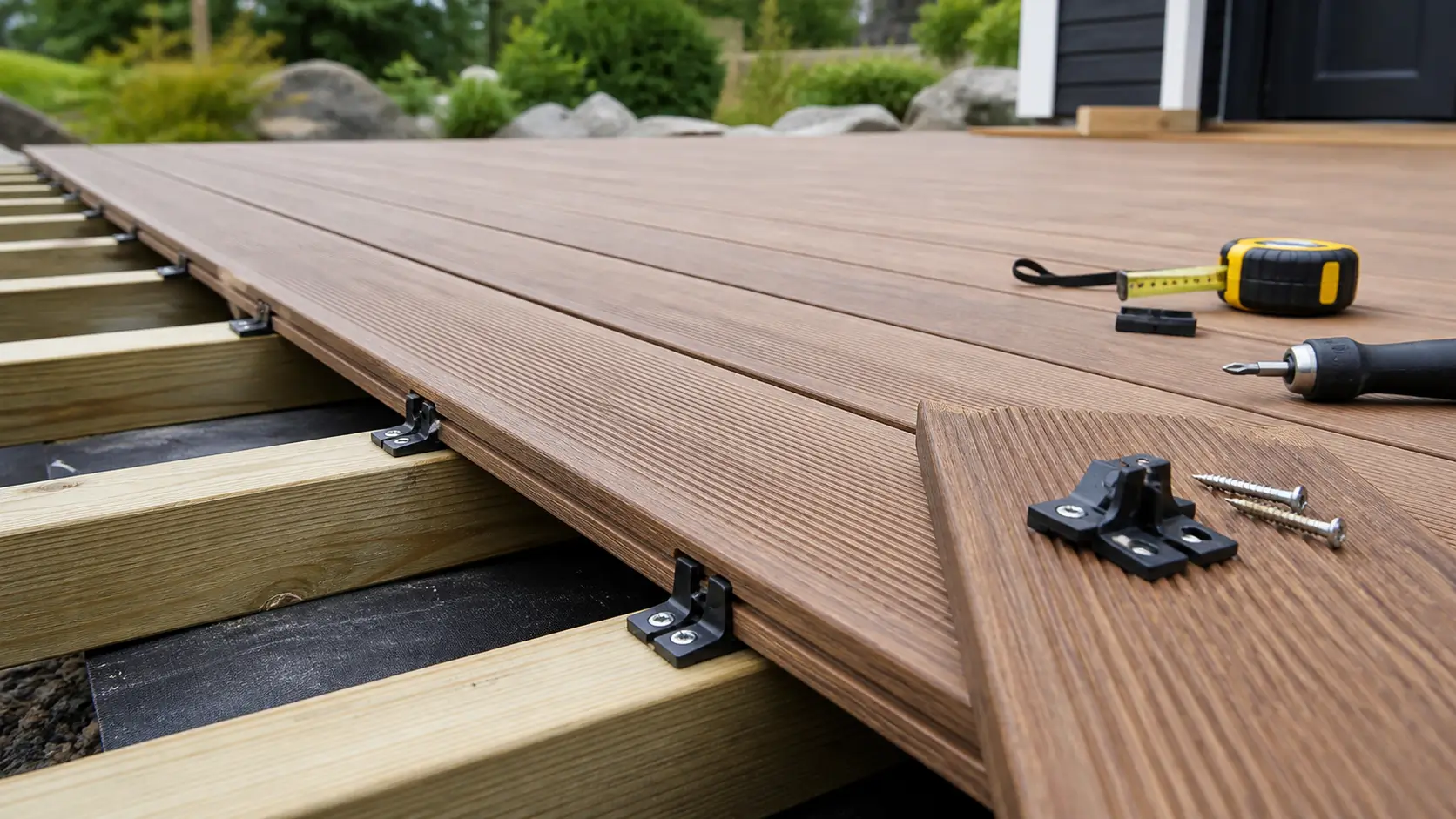
Hidden deck fasteners hold deck boards with clips, brackets, or side-driven screws instead of visible screws through the walking surface. The result can be a cleaner and calmer deck surface, especially with grooved composite boards or decking systems designed for clips.
They are not automatically the best choice. Hidden fastening needs the right board profile, the right clip system, careful installation, and usually a little more planning than face screws. Before you order materials, it helps to know what the system changes.
How hidden fasteners work
Many systems use clips that sit in a groove along the side of each deck board. The clip is screwed into the joist, then the next board slides into place. Some clips also set the gap between boards.
Other systems use angled screws, plugs, or special brackets. The idea is the same: the fastener secures the board without leaving a visible screw head on the surface.
Always check the installation guide for the exact board and clip you plan to use. Hidden fasteners are often designed for specific board profiles, framing layouts, and decking materials.
When clips make sense
Hidden fasteners work best when the board is made for the system and the finished look matters. They are especially relevant when:
- the boards have side grooves
- you are using composite decking or a system-specific board
- the deck has large visible areas
- you want to avoid visible screw lines
- the manufacturer recommends or requires hidden fastening
On a modern deck with long straight runs, clips can create a very tidy result. They can also reduce visible screw heads and splinters on the walking surface.
When face screws are still smarter
Face screws are still a good choice for many wood decks. They are easy to understand, simple to inspect, and often faster for a homeowner to install.
Visible deck screws may be smarter when:
- you use standard wood boards without side grooves
- the budget is tight
- you want easier board replacement later
- the deck has many small cuts, stairs, or edge boards
- function matters more than a fastener-free appearance
The important question is not whether the fastener is visible. It is whether the fastening method suits the board and the structure.
What to add to the material list
Hidden fastening changes the material list. You may need clips, starter clips, end clips, system screws, plugs, or special driver bits.
Before you buy, check:
- how many clips are needed at each joist
- whether board joints need extra clips or double joists
- whether the first and last boards need special fasteners
- whether stairs and edge boards still need face screws
- whether the system requires a specific bit or drill setup
Use the deck calculator first to estimate decking and basic screw needs. Then add clips and system parts from the manufacturer’s table. If you are still planning the frame, review joist spacing for deck boards because spacing changes the number of fastening points.
Benefits of hidden fasteners
The main benefit is appearance. A surface without visible screw heads often feels cleaner, especially on boards with consistent color and straight lines.
Clips can also make board spacing more consistent when the clip acts as a fixed spacer. That helps on larger deck surfaces.
Some clip systems slightly separate the board from the joist, which may help drying. That does not replace proper drainage, airflow, or a sound substructure.
Drawbacks to consider
Hidden fasteners usually cost more than standard deck screws. The clips cost more, and installation can take longer if you have not used the system before.
Replacing one board in the middle of the deck may also be harder. Some systems require loosening several boards to reach the damaged one.
The system also leaves less room for improvisation. Uneven joists, boards that are not straight, or clips tightened incorrectly can lead to uneven lines or noise.
Practical installation tips
Read the guide before the first row is fixed. Many systems have separate rules for starter boards, end boards, butt joints, and border details.
A few habits help:
- confirm that the board profile and clip match
- keep the joists flat and stable
- use the correct bit and drill torque
- do not force boards so tightly that the clip gap changes
- plan face screws where clips cannot be used
- buy a few extra clips for waste and small adjustments
If you are comparing hidden clips with visible screws, read the deck screw spacing guide. It makes the tradeoff clearer.
Short version
Hidden fasteners are a good choice when your decking is designed for clips, you want a clean surface, and you are ready to follow the system guide carefully. Standard deck screws are still a reliable, simpler, and often cheaper choice for many wood decks.
Start by estimating the boards, check the framing, then add clips, starter fasteners, and any special screws. That gives you a cleaner result and a material list that includes the small parts the deck depends on.