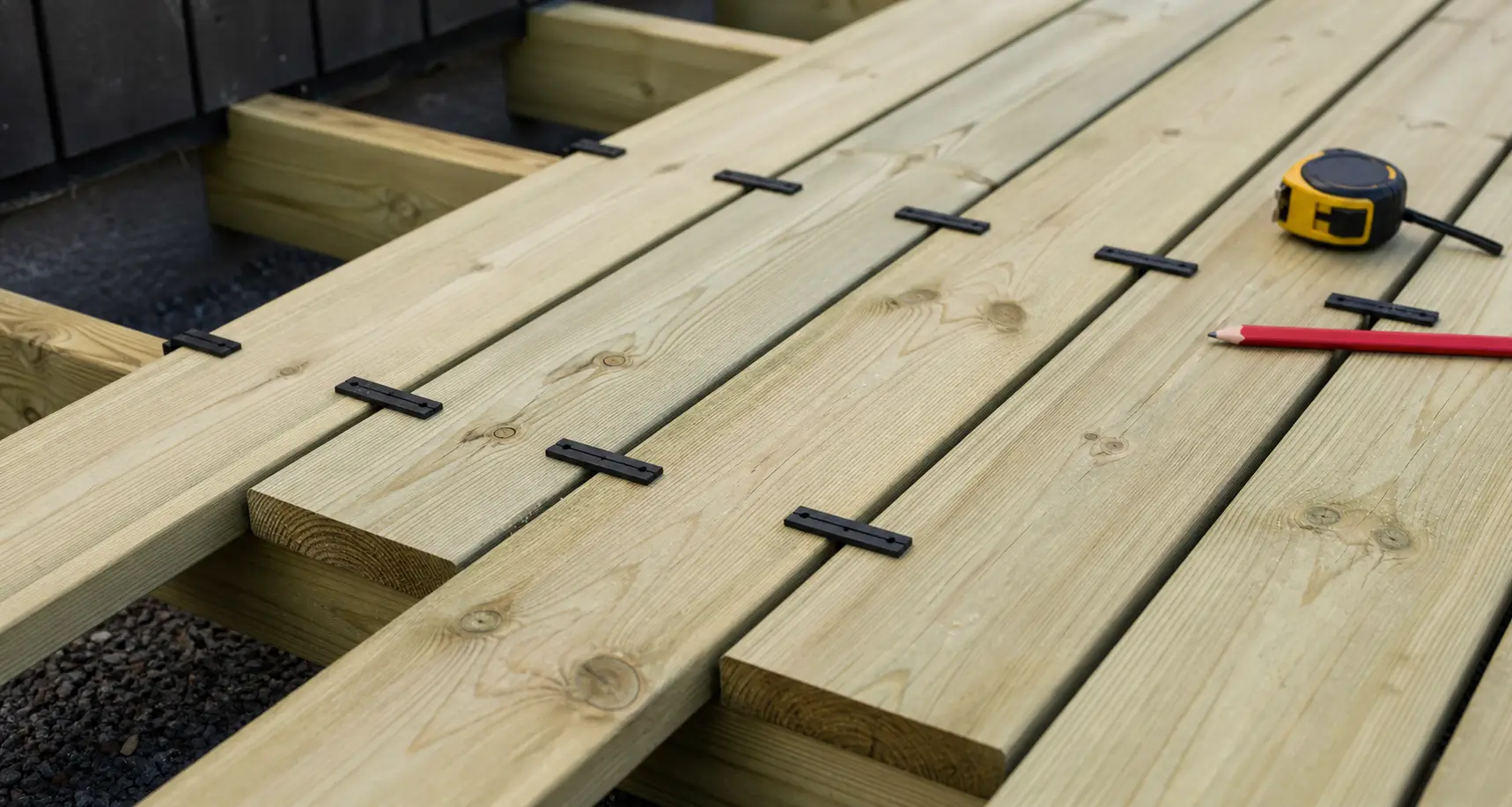
The gap between deck boards looks like a small detail when you are setting the first board on the frame. In practice, it affects drainage, airflow, cleaning, appearance, and how much decking you need.
Too little gap can hold water and dirt. Too much gap can make the deck look busy, expose more of the framing, and feel less comfortable underfoot. The goal is not to find one magic number. It is to choose spacing that fits the material, the moisture level of the boards, and the installation guide.
A practical starting point
For many wood deck boards, 3 to 5 mm, or roughly 1/8 to 3/16 inch, is a practical planning range. Many installers start near 3 mm when boards are fairly dry and straight, but the right gap depends on the product in front of you.
Always check the manufacturer’s installation instructions. Wet pressure-treated boards, kiln-dried boards, hardwood, thermally modified wood, PVC, and composite decking can all have different spacing needs.
Consistency matters as much as the number. A deck with 3 mm gaps in some rows and 8 mm gaps in others quickly looks less precise than a deck with a clear, even rhythm across the surface.
Wet and dry boards move differently
Pressure-treated lumber can be heavy and wet when delivered. Those boards often shrink as they dry. If you leave a large gap while they are still wet, the final gap may become larger than you wanted.
Drier boards still move, but they usually have less shrinkage left. In that case, leaving a visible gap during installation may be the better choice.
Check these things before deciding:
- whether the boards feel unusually heavy and wet
- whether they have been stored in rain
- whether they came from a tightly wrapped bundle
- whether the material is kiln-dried, thermally modified, hardwood, or composite
- whether the supplier gives a specific spacing requirement
If in doubt, the product guide matters more than a general rule of thumb.
Why the gap matters
The gap between boards does several jobs.
It gives water a path down through the deck. It helps leaves, dust, and small debris move through instead of sitting in long channels. It also gives the board edges some airflow, which can help the surface dry faster after rain.
Without enough spacing, water can stay on the deck longer. Over time that can mean more dirt, slippery areas, and more moisture load on both the boards and the joists.
Bigger is not automatically better. A very wide gap can catch larger debris, make it easier to drop small items, and show more of the substructure below.
Use spacers
Deck spacers, spacing tools, a thin strip, or a fixed template make the installation calmer. You do not have to measure every gap from scratch.
A simple workflow:
- lay out a few boards loose before fastening
- use the same spacer size across several rows
- check that the boards are still running straight
- adjust before locking the row with screws
- make sure the final board will not become a very narrow strip
That final point is easy to miss. If the deck depth does not work neatly with board width and gap, spread a tiny adjustment across many rows. The edge will usually look better than if all the mismatch lands on the last board.
Spacing affects the material estimate
When you estimate decking, board width is not the only number. Each row covers the board width plus the gap to the next row. That means 3 mm, 5 mm, and 6 mm spacing can produce slightly different row counts on the same deck.
The difference is rarely dramatic on a small platform, but it can matter on larger surfaces. It can also change the number of screw lines or hidden-fastener lines.
Use the deck calculator with a realistic board width and gap. If you are still choosing board dimensions, read how deck board width affects material needs.
Face screws and hidden fasteners
With face screws, you can adjust each board before fastening it. That gives you flexibility when boards are slightly bowed, but you have to keep checking the gap as you work.
With hidden fasteners, the clip often sets much of the gap. That can create a very even surface, but only when the board profile, clip, and framing are compatible. Do not force boards so tightly together that the clip can no longer create the spacing it was designed for.
If you are considering clips, read hidden deck fasteners. It explains how the fastening method affects the appearance, installation, and material list.
Common mistakes
The most common mistakes are rarely about one millimeter. They happen when spacing is not planned.
Avoid these:
- installing dry boards tight without checking the guide
- leaving too much gap between wet pressure-treated boards
- changing spacer tools in the middle of the deck
- pulling bowed boards so hard that the gap varies
- forgetting stairs, borders, house walls, and edge boards
- treating composite decking like ordinary wood
Composite and system boards can have specific side-gap and end-gap requirements. Follow the system, especially where board ends meet.
Short version
Start with the manufacturer’s installation guide. For many wood decks, 3 to 5 mm, or about 1/8 to 3/16 inch, is a useful planning range, but wet pressure-treated boards may need less gap at installation because they shrink as they dry.
Use fixed spacers, dry-fit a few rows, and calculate the full deck depth before fastening everything. You will get better drainage, cleaner lines, and a more realistic material estimate.