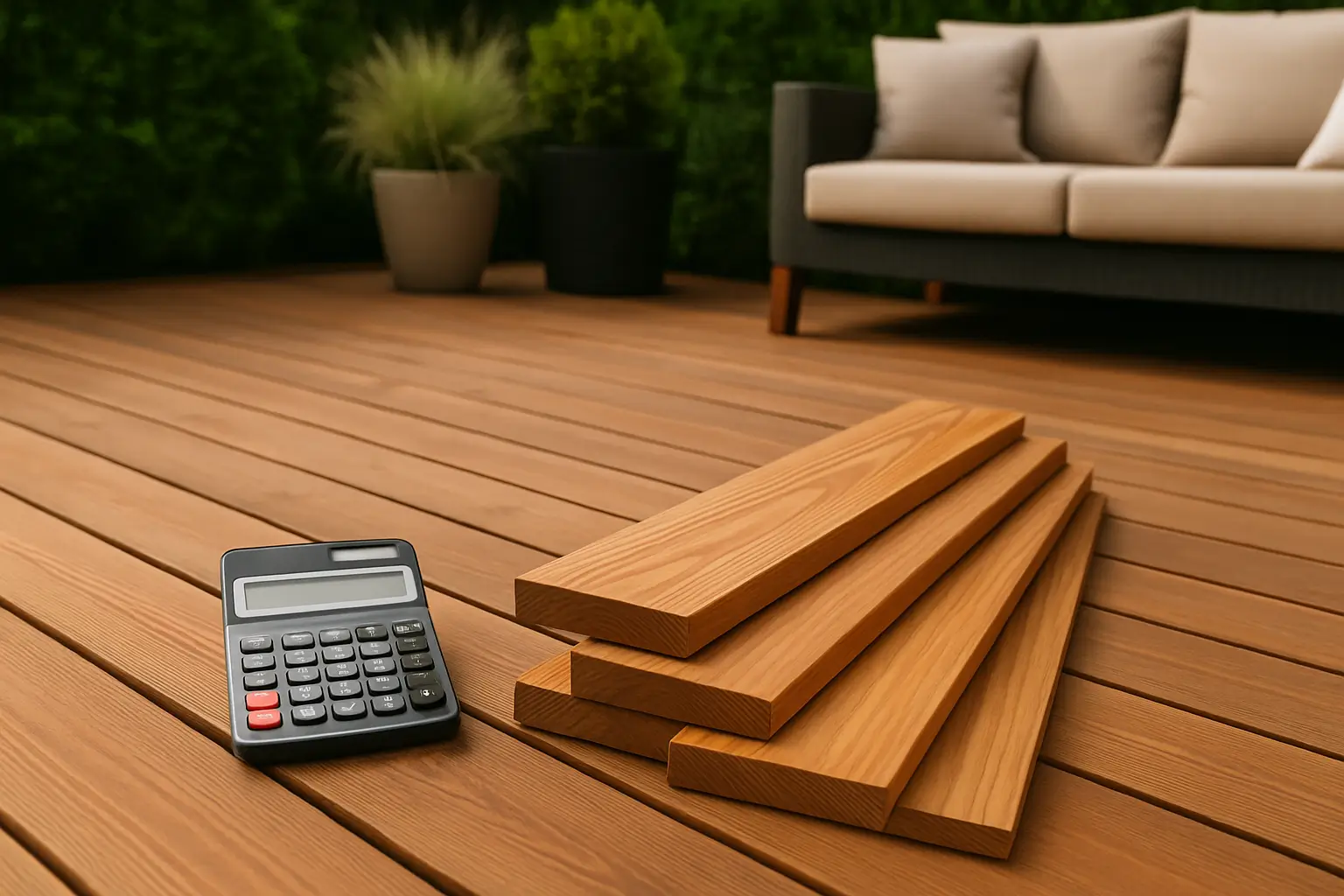
A ground-level deck (or platform deck) is in practice a low deck that sits right on the ground – and the material estimate follows the same rules as for any deck: about 8.3 linear meters of board per m² with 120 mm (4 3/4 in) wide boards – roughly 2.5 linear feet per sq ft – 35–40 screws per m² (3–4 per sq ft), plus about 10 % waste allowance. A deck platform calculator does the math for you from the platform’s dimensions and the board width you choose.
Ground-level deck vs. raised deck – what is the difference?
The terms are often used interchangeably, but in practice they differ like this:
- Ground-level deck: a low structure close to the ground, usually without railings or stairs. If the entire platform sits no more than about 0.5 m (20 in) above grade, the building rules are usually simpler – in many places it can sit close to the property line. See the details in can you build a deck without a permit?
- Raised deck: elevated off the ground, needing real load-bearing structure, possibly railings (commonly required above a 0.5–0.75 m / 20–30 in drop, depending on local code), and stairs.
For the calculator, the principle is the same – it is the surface area that gets estimated. The difference lies in the substructure and the rules.
A foundation for a low platform
Even though the platform sits low, it needs a stable, draining base:
- Remove the turf where the platform will sit, and level with a layer of crushed stone or gravel.
- Lay landscape fabric under the gravel to stop weeds and keep the gravel from mixing into the soil.
- Use concrete pavers or blocks as bearing points for the joists – adjustable and easy to level. Ground screws are a good alternative on uneven ground.
- Allow airflow: The joists should never lie directly on the ground. A little clearance gives ventilation and prevents rot. More on this in why drainage under a deck matters.
Set the joists at 60 cm (24 in) on center for 28 mm (about 1 in) deck boards, or 40 cm (16 in) for thinner boards or diagonal layouts.
Estimate: materials for common platform sizes
With 120 mm (4 3/4 in) wide deck boards, including about 10 % waste allowance:
| Platform | Area | Deck boards | Screws |
|---|---|---|---|
| 3 × 3 m (10 × 10 ft) | 9 m² | approx. 82 lm | approx. 320 |
| 4 × 3 m (13 × 10 ft) | 12 m² | approx. 110 lm | approx. 430 |
| 4 × 4 m (13 × 13 ft) | 16 m² | approx. 147 lm | approx. 570 |
| 5 × 4 m (16 × 13 ft) | 20 m² | approx. 183 lm | approx. 715 |
The numbers are rounded and indicative. If you choose narrower boards (95 mm / 3 3/4 in), the linear requirement rises to about 10.5 lm per m² – the full conversion is in deck boards per square meter.
How to use the calculator
- Measure the platform’s length and width.
- Enter the dimensions and the board width into the calculator on this page.
- Get linear length of decking and the number of screws as a shopping list.
- Round up to whole board lengths, and keep a small buffer – see deck board waste allowance for when you should increase it.
If you are not sure whether you actually need a calculator for a platform, a deck, or something more, deck calculator or decking calculator – what do you need? gives you the overview.
Frequently asked questions
Do I need a permit to build a ground-level deck?
Usually not. A platform that sits no more than about 0.5 m (20 in) above grade is exempt from permits in many jurisdictions and can often be placed near the property line – but the thresholds vary by country and municipality, so always check your local zoning rules.
How many deck boards do I need for a 12 m² platform?
With 120 mm boards: 12 × 8.3 ≈ 100 linear meters, plus about 10 % waste ≈ 110 linear meters (about 360 linear feet). That corresponds to roughly 26 boards at 4.2 m (14 ft).
Can I lay a platform directly on the grass?
No, that leads to rot and settling. Remove the turf, lay landscape fabric and gravel, and use pavers, blocks, or ground screws as bearing points so the wood gets airflow.
Which boards are best for a ground-level deck?
Pressure-treated 28 × 120 mm (roughly 5/4 × 5) is the standard choice and the cheapest. Premium treated wood or composite needs less maintenance – compare the options in how to choose the right deck material.